
RSC The Resistible Rise of Arturo Ui review - Mark Gatiss brings shabby terror to Brecht classic
Peter Ormerod reviews The Resistible Rise of Arturo Ui, by Bertolt Brecht, translated by Stephen Sharkey, presented by the RSC at the Swan Theatre, Stratford
Subtlety be damned. This is a straight-up, scorching, in-your-face depiction of the methods by which demagogues gain power.
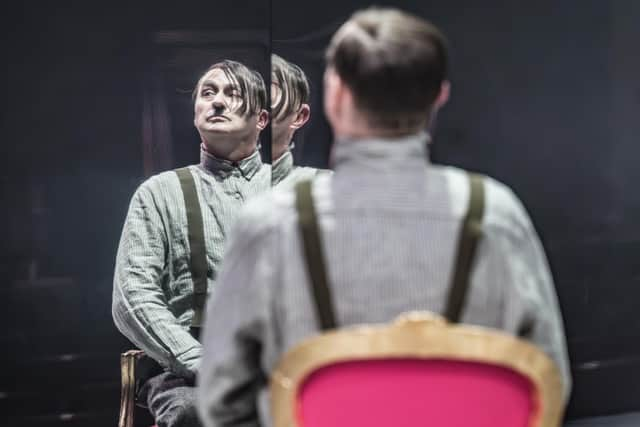

Written in 1941 by the exiled German playwright Bertolt Brecht, The Resistible Rise of Arturo Ui ostensibly tells of a Chicago gangster who achieves supremacy through emotional manipulation, scapegoating and violence. It is of course really about Adolf Hitler, and there is no attempt to suggest otherwise: as the story unfolds, the parallels with 1930s Germany are described explicitly on a screen and through vocal declaration. For example, an arson attack at a warehouse equates to the burning of the Reichstag; a massacre of Ui’s rivals equates to Hitler’s assassination of his opponents; and so on. Ui has a toothbrush moustache and a civilised exterior that conceals terrifying wildness.
It is usually inadvisable for theatre to be quite so direct, but this sense of unambiguous urgency is what powers the play and this exhilarating production. There are no moral debates to be had here: there is some examination of the propensity for good people to fall passive in the face of evil, but nuance and hand-wringing are not really the point. And as the play is as much prophecy as history, the audience is challenged to be alert to the ways of the dark spirits of this age.
Ui is played by Mark Gatiss in what may well be his best performance to date. His Ui begins as a shabby, shambling, oily loser; it is quite a feat that these traits are still discernible at the end, when he stands uniformed and imperious. One could hardly call Ui cunning or sophisticated in his methods; he is essentially base, and panders to the baseness of others, using the physical strength of his acolytes to compensate for his own puniness. Unlike Hitler, Ui's actions seem to lack any ideological motivation, but perhaps this helps the warnings to ring out more clearly: men like him can use anything to justify horrors.
Gatiss is one of three star turns. The second is the Bafta-winning comic actor, comedian and writer Mawaan Rizwan, who gets proceedings under way with a spot of stand-up, dressed as a member of RSC staff in a scene exemplifying Brecht’s desire to expose the artifice of theatre. He is nimble of body and wit throughout, and is at some points the scariest figure here. And the third star is the band Placebo, who have composed a primal and pulverising score, often conjuring a kind of hypnotic terror. Their work is integral to the success of the production.
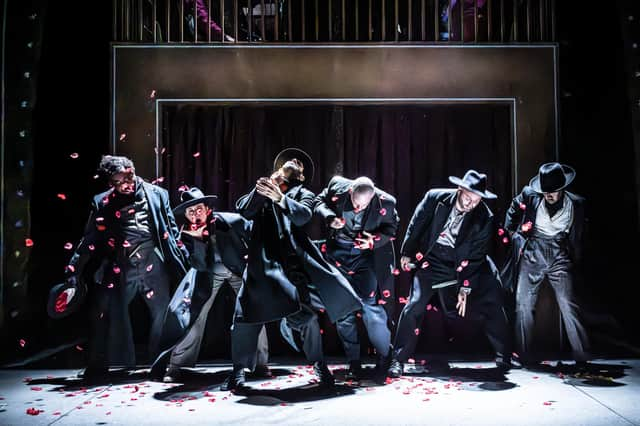
Seán Linnen directs it all with abundant flair, but Georgina Lowe deserves equal billing for her set and costumes. Inspired by German Expressionism and 1930s Chicago, her vision of “neon colours against the natural timber of The Swan, characters that live half in reality and half in a graphic novel” is fulfilled quite breathtakingly. The sheer theatricality is off the scale. ‘Brechtian' is often used as a synonym for stark: this is anything but, yet it surely remains true to Brecht’s ideas, establishing his intended distance between audience and performance.
This is in no way a moving, heartwarming or inspiring show. It isn’t meant to be. What hope there is can be found in the title. Ui’s rise was resistible: a damning word, but one that suggests that power lies with us.
Until May 30. Visit rsc.org.uk or call 01789 331111 to book.